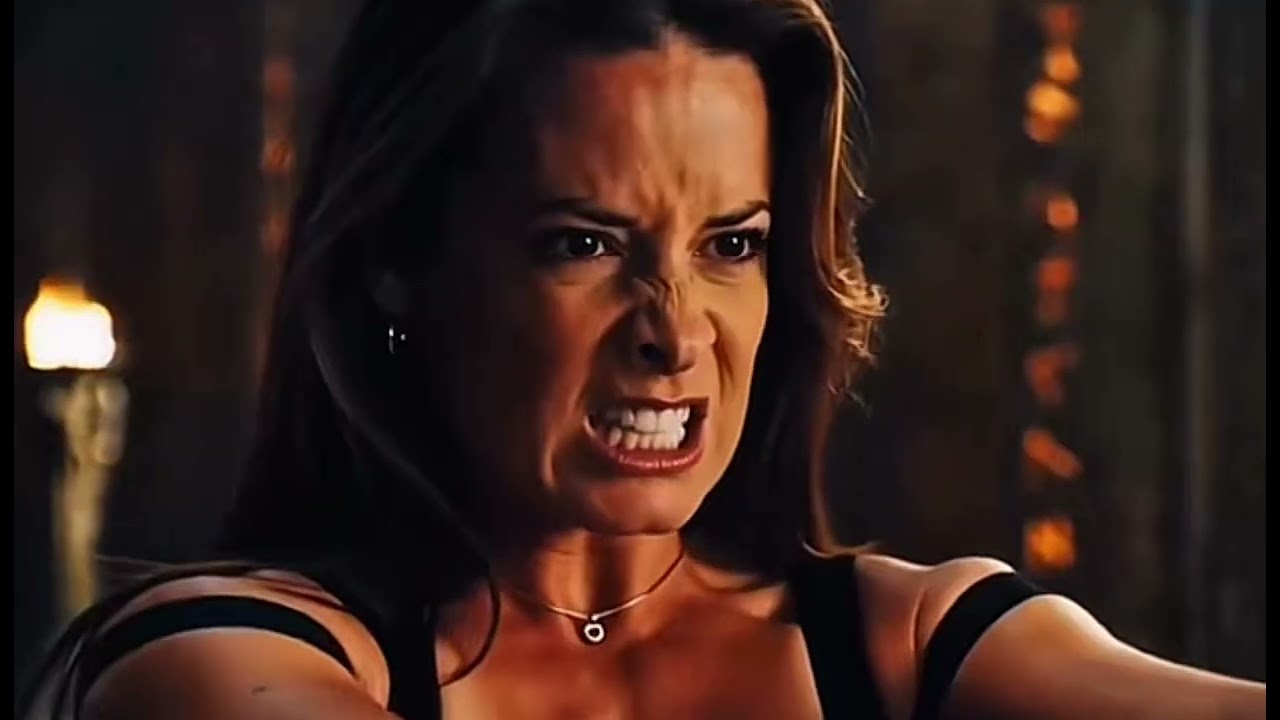
This isn’t just another nostalgic revival—it’s a full-scale cinematic experience that somehow turns witchcraft, artificial intelligence, and emotional trauma into one addictive supernatural war. And honestly? I didn’t expect it to go this hard.

What starts as a familiar return to the Manor quickly spirals into something much darker, bigger, and surprisingly emotional. Then… everything changes.

A Spectacle Worth Watching on the Big Screen
The moment the Book of Shadows becomes digital, the entire atmosphere shifts. The film takes the classic magical mythology fans remember and injects it with modern paranoia—viral networks, hacked consciousness, corrupted spells, and a terrifying idea:

What if evil no longer needed a body?
The Source of All Evil returns not as a demon in the shadows, but as a self-evolving digital virus capable of infecting both technology and magic itself. It’s ridiculous on paper.
On screen? Somehow it works.
The scale feels bigger than anything the franchise has attempted before. Cities collapsing into magical blackouts. Global communication systems freezing midair. Entire crowds turning into possessed extensions of a digital hive mind.
And at the center of it all is the emotional heartbeat that longtime fans came for.
Why This Story Feels Bigger Than Nostalgia
What surprised me most wasn’t the action.
It was the tension between the sisters.
Piper carries exhaustion in every scene, and Holly Marie Combs absolutely understands the assignment here. She doesn’t play Piper like a superhero anymore—she plays her like a woman who has spent decades holding reality together with sheer willpower.
Meanwhile, Phoebe becomes the film’s emotional engine. Alyssa Milano leans heavily into the psychic horror angle, especially during the astral premonition sequences where memories, timelines, and digital hallucinations begin blending together.
Some of those scenes are genuinely unsettling.
But here’s what most people missed…
The real conflict isn’t magic versus technology.
It’s connection versus isolation.
The villain spreads through frequency, code, and fear. The sisters survive because of trust, history, and emotional synchronization. Corny? Maybe a little. Effective? Absolutely.
The Scene That Stole the Show
There’s one sequence about halfway through the film that completely changes the energy of the story.
Piper freezes time across a collapsing global network while Leo navigates celestial bureaucracy to locate a loophole buried inside the Eternal Covenant itself. At the exact same moment, Phoebe enters a corrupted astral plane where human memories are being rewritten by the virus.
The cross-cutting during this scene is incredible.
Fast. Chaotic. Emotional.
And then the soundtrack drops out completely for a few seconds.
Silence.
Just frozen screens and distant whispers.
That scene alone feels like something pulled from a much larger-budget sci-fi franchise.
What Works Extremely Well
- The chemistry still feels authentic: The emotional connection between the core characters never feels forced.
- The horror elements are stronger than expected: Some scenes lean surprisingly psychological.
- The tech-magic concept feels fresh: It could have been cheesy, but the execution gives it real momentum.
- Visual effects are surprisingly solid: Especially during the network-collapse sequences.
- The pacing rarely slows down: Once the conflict escalates, the film moves fast.
Where the Film Struggles
Not everything lands perfectly.
A few exposition-heavy scenes overload viewers with lore and celestial politics. Casual audiences unfamiliar with earlier mythology may feel slightly lost during parts involving the Covenant rules and cosmic loopholes.
The digital virus concept also pushes the franchise into almost sci-fi territory, which may divide longtime fans who preferred the gothic supernatural tone of earlier stories.
Still… even the weaker moments are carried by sheer energy.
Why Fans Are Already Talking About It
The movie understands something many revivals forget:
Fans don’t just want references.
They want evolution.
This story doesn’t simply recreate old magic—it modernizes fear itself. Instead of demons hiding underground, evil spreads through algorithms, networks, and invisible systems people trust every day.
That idea lingers longer than expected.
Especially after the final act.
And yes… the ending absolutely leaves the door open for more.
Very intentionally.
What Viewers Are Saying
- Daniel Brooks: “I expected nostalgia bait. Instead I got one of the coolest supernatural sci-fi crossovers I’ve seen in years.”
- Samantha Reed: “The frozen-network scene gave me chills. Literal chills.”
- Marcus Hill: “Way darker than I expected—in a good way.”
- Emily Carter: “Holly Marie Combs absolutely carries this movie emotionally.”
- Tyler Jensen: “The tech-virus concept sounded insane at first… but they actually made it work.”
- Rachel Moore: “Phoebe’s astral sequences were honestly terrifying.”
- Kevin Lawson: “It feels bigger than old-school supernatural TV. More cinematic. More intense.”
- Olivia Bennett: “I went in skeptical and left wanting another sequel immediately.”
Final Verdict
What makes this comeback surprisingly effective is that it never relies solely on nostalgia. Underneath all the visual spectacle, magical chaos, and digital horror is a story about people trying to hold onto each other while the world becomes increasingly disconnected.
And weirdly enough… that’s what makes it hit.
It’s messy sometimes. Overambitious occasionally. But forgettable?
Not even close.
If you grew up with supernatural fantasy dramas, this feels like watching an old spellbook evolve into something far more dangerous.
And honestly, I kind of loved that.
Frequently Asked Questions
Is this movie connected to the original story?
Yes. The film heavily continues the original mythology while expanding it into a much larger supernatural universe.
Do you need to watch previous installments first?
It helps, especially for understanding character relationships and magical lore, but new viewers can still follow the core story.
Is the movie more horror or fantasy?
It blends both surprisingly well. There are emotional fantasy elements mixed with psychological horror and sci-fi tension.
Is it worth watching in theaters?
Absolutely. The visual effects and large-scale magical sequences feel designed for a big screen experience.
Does the ending set up another sequel?
Without spoiling anything—yes. And the final minutes make that very clear.